Proper 22 - Year B
Pentecost 19
Mark 10:2-16
“Whoever divorces his wife and marries another commits adultery against her and if she divorces her husband and marries another, she commits adultery.”
I wish he hadn’t said that. Not that way. If Jesus is this matter-of-fact on the subject where does he leave my parishioners who don’t fit the mould? For that matter where does he leave their parish priest - himself a divorced and remarried man? This came up online with my pals during the week: “What are y’all doing with the unequivocal words of Jesus about divorce and remarriage in your congregations this Sunday?" Suggestion number one from Nigel – “Preach on something else. Psalm 8 perhaps”. It’s what a former Archbishop of Canterbury did a few years back on this particular Sunday, effectively dodging the bullet. Suggestion number two from Kenny – “Nah Rob; be a Scotsman and wade right in”.
“Okay, fab, Kenny! You’re a pukka Scotsman. Is that what you’re doing?”
“No, we’ve got Harvest Thanksgiving this Sunday. Different readings, the church decorated with squash and bulrushes – ‘We Plough the Fields and Scatter’ and all that jazz.”
Which leaves me alone, therefore, with a Gospel reading in which I am quite explicitly named as a malefactor - as are a selection of you reading this. We resemble that remark. It does no justice to the Scripture to imply that Jesus is doing anything other than underlining the sinful state of humanity: our humanity in general - yours or mine in particular this Sunday. If there’s to be a “Yes, but…” anywhere in the sermon let it come at the end rather at the beginning. Well-aimed arrows of judgement should not simply be batted aside at the outset. It wouldn’t be right. It wouldn’t be true. The death of our relationships speaks volumes about our weakness and our sin. Eh, voila! There we are - standing on sinners’ corner.
Sinners’ corner is the place where we belong – all of us. It will do no good to traipse up to Jesus, as some did during his earthly ministry, to say “You didn’t specifically name me, did you Jesus? I’ve kept the rules since my youth, haven’t I?” As will be explained to any who hold such misconceptions about being off the hook; the commandment against murder can be extended to anger and the commandment against adultery even to our fleeting lusts. Those who can remember the day and the year when everything came tumbling down – those who find they’ve been named in the 10th chapter of Mark – may here be the lucky ones. You never know. Don’t count yourselves too quickly amongst the sheep. Don’t assume that you’re the only goat in the room. It took the disciples far too long to arrive at the place where they could finally exclaim “Who, then, Lord can be saved?”
They would come to understand: This was not the end of the line. It was only the starting point
Thursday, October 01, 2015
Thursday, September 17, 2015
Proper 20 - Year B
Pentecost 17
Proverbs 31:10-31
The jury is still out on whether or not I will risk wading into the 31st chapter of the Book of Proverbs in my sermon this Sunday - the reading which takes as its subject: "A Capable Wife" or in slightly grander language "A Wife of Noble Virtue". Is my skin thick enough and are my shoulders sufficiently broad to take the repercussions of somebody thinking that I got it wrong?
I want to preface these remarks by stating at the outset that I am married to a Wife of Noble Virtue, was raised by one back in British Columbia and that my daughter in Montreal seems well on the road to taking her place in such a designation within her generation. Women of Noble Virtue loom large in my extended family and many of them were, in fact, married. That primary relationship and the household which came with it formed part of the springboard from which their nobility and the virtue could flow effectively in their day and age.
One chief objection to the first reading this Sunday from Proverbs is that the "capable" or "virtuous" wife being described here seems to work her fingers to the bone. She is in the house, around the house, supervising servants, steering the children forward, haggling with merchants, spinning and weaving, caring for the poor and, above all, being the engine of economic and moral activity in her family. Her husband seems to spend his time at the city gates with his friends. No other sphere of activity is specifically credited to him.
There's quite a lot in the Book of Proverbs about wives. Not all of the reflections there are particularly illuminating or helpful and we tend to move from those negative appraisals of women to then tumble upon this reading about a woman who seemingly has the labours of the world piled upon her back. This reading suffers badly from the comments and opinions of folks who haven't read it through on its own merits. Read it, will you? The woman described herein is a beacon to her village or town. She is a moral and economic giant within her family and her local community. She is a force to be reckoned with.
We are blessed at Christ Church with a full complement of high school girls. While they may not choose to live their lives in the shadow and pattern of the woman described in this Sunday's Old Testament Lesson they will, I hope, think kindly of a woman who seizes the challenges of her day with an iron grip and made things happen.
Girls of Christ Church - take note.
If there's anything to be improved upon or departed from in this passage about the Wife of Noble Virtue it might be in the woman's choice of a husband. We look in vain for any evidence of his substantial contribution to his age and generation.
Boys of Christ Church - take note.
Posted by
Raspberry Rabbit
at
9/17/2015
0
comments
Labels: 500 words on a reading, Year B Readings
Saturday, September 12, 2015
Proverbs 1:20-33
hospitals will recognize that situation where you stand there looking at somebody who has so much raw potential and yet is still not ready for certain responsibilities which require a sort of "smarts" which can only be given by deep reflection, by an experience of both success and failure and by a breadth of knowledge which raw organic intelligence itself does not give.
Posted by
Raspberry Rabbit
at
9/12/2015
0
comments
Labels: 500 words on a reading
Friday, September 04, 2015
Proper 18 - Year B
Mark 7:24-37
They demonstrate, for our benefit, the power of sheer bloody-mindedness.
Posted by
Raspberry Rabbit
at
9/04/2015
0
comments
Labels: 500 words on a reading, Year B Readings
Friday, July 24, 2015
The Ninth Sunday after Pentecost
Proper 12 -Year B
Ephesians 3:14-21
"..and that Christ may dwell in [their] hearts through faith, as [they] are being rooted and grounded in love."
He prays as well that they
"...may have the power to comprehend, with all the saints, what is the breadth and length and height and depth, and to know the love of Christ that surpasses knowledge, so that [they] may be filled with all the fullness of God."
members, former friends and enemies recognized in the lives of those whom Christ had seized that these people were being changed and were no longer who they once were. This change then led to understanding (the power to comprehend) how these inner changes were in fact consonant with what God was doing in the world and in the lives of others; there was both evidence within the believer and evidence without.
"...by the power at work within us is able to accomplish abundantly far more than all we can ask or imagine".
Posted by
Raspberry Rabbit
at
7/24/2015
0
comments
Labels: 500 words on a reading
Thursday, July 09, 2015
Proper 10 - Year B
The Seventh Sunday after Pentecost
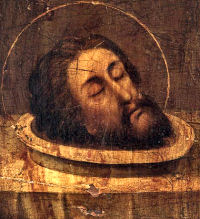
Mark 6:14-29
"When [Herod] heard [John the Baptist], he was greatly perplexed; and yet he liked to listen to him"
Critics. We've all got 'em. The more we do and the greater the risks we take the higher our degree of vulnerability to such criticism. If we play safe, though, we are criticized for that too.
Critics - blast them! Why don't they leave me alone?
Herod Antipas (a Roman client-governor based on the Western shore of the Sea of Galilee) was a curious fellow with an odd love-hate relationship to his greatest critic - John the Baptist. The Baptist had zeroed in on improprieties in Herod's family life - most especially his marriage to Herodias, the former wife of his brother Philip Antipater. Whenever John preached, though, Herod would always listen. He was both "perplexed" (set back, troubled or confounded) by the Baptist's critical preaching and yet, at the same time, strangely compelled to pay attention. Aren't we most angered by those words of criticism which resound somewhere within us? We worry that they might be true. We find that they mirror what others have said about us before. Those ultimately caught in a significant fault by their critics will say it was something they knew themselves all along. It didn't come as a surprise.It's not impossible to turn such a voice off - it can always be done.
You will distance yourself from a meddling friend. You can destroy your enemy. You might school yourselves that the voice within you is just some neurotic nagging force which is best not-listened-to. You could avoid those Scriptures which trouble you. It happens all the time.
There can be no road now out of the hole he's dug for himself - no one left to shake the branch he's sitting on.
Posted by
Raspberry Rabbit
at
7/09/2015
0
comments
Labels: 500 words on a reading
Wednesday, July 08, 2015
The Eighth Sunday after Pentecost Proper 11 - Year B
Psalm 23
What is it that we keep around for a rainy day? An awful lot of life's activity consists of collecting resources for ourselves and our families. It's always been that way. If your hobby is metal detecting you live in hope of finding one of those coin hordes which some punter, centuries ago, hid from the taxman in the fourth tree to the left of the bend in the old road.
That the teenager with the metal detector even found the coins meant that the original owner was never able to collect them back in the day. That datum, in itself, should tell you something.
As I was sitting in my office this week looking at Sunday's readings I realized two things; that the 23rd Psalm is very popular (I know at least four different ways of singing it) but that most folks would regard the sort of reliance upon God which the psalm prescribes as being a sign of personal failure on their part. If you are walking "through the valley of the shadow of death" then you must have taken a wrong turn at Albuquerque. You could be reproached for that. If you are relying on God to lead you "in green pastures" or "beside still waters" or to place a cup in your hands which "floweth over", then where exactly was your brain when you were planning your life? The psalm may be popular but we take it as a big part of our life's work never to be in a place where its precepts and promises become necessary. We strive for self-reliance. We've been told that there's a science to it. With a bit of self-discipline it can be done. We don't need to rely on God.
The Church (at least in the First World and since the Second War) has often played along with this. More's the pity really. A quick side glance at world history will tell us that civilizations rise and fall. We can count ourselves merely lucky to be living where and when we do. Every second page of the New Testament seems to subvert - in parable and pronouncement - the idea that self-reliance is the normal human condition. Where such self-reliance is even possible due to accidents of history and geography, rarely is it pious. Our "great cloud of witnesses" contains all those saints (not to mention the philosophers, the aid-workers, the poets and the musicians and other sundry heroes) who forswore their place on the upward path towards "their piece of the pie" in order to embrace the beauty and the sense of a life that could only be found when uncertainty is sought out and embraced.
What makes us safe and well-equipped does not necessarily make us deep or useful. It cannot ensure that we are good.
Posted by
Raspberry Rabbit
at
7/08/2015
0
comments
Labels: 500 words on a reading
Thursday, July 02, 2015
The Sixth Sunday after Pentecost
Proper 9 - Year B
Mark 6:1-13
What is it about your home town that allows you to blend in so easily when you go back? You're bound to bump into somebody who'll think you've never been away and assumed you'd simply been lying low and keeping to yourself. The pendulum in your head swings back and forth several times between "Yes, this is where I belong"and "No, this is certainly no longer who I am". Some of you have recently been repatriated to the U.S. after a number of years in France. Many of us will return to our home countries for holidays at some point in the summer and will find ourselves reconnected to
family members or old friends. It may prove a challenge.
We should not stretch this passage out of shape by relating it too swiftly to ourselves. This is not a passage about us. This story is about Jesus. The words at the beginning of Mark's Gospel had indicated to the reader that Jesus is one who belongs to God: "You are my beloved Son...", declares the voice from heaven at the Jordan. The townsfolk in Nazareth, though, state that Jesus belongs to them and that he is dead ordinary: "Is not this the carpenter, the son of Mary...". What is more significant here is that they "took offense at him". Belonging to them meant staying where he had been - nailed into place within the bounds set by elders. Jesus had stepped beyond the life set down for him by his community. God has greater plans that that.
The worthies of Nazareth do not understand what the reader of Mark's Gospel will have understood: In God's hands, the humanity, the origins, the language and culture, the village education and even the intimate family connections of Jesus of Nazareth are a means God will use to move out beyond limits, to move the goal markers, to cross boundaries, to speak truth within a particular religious tradition in order that truth might be spoken within other cultures and religious traditions. Empires are overturned and subverted. The poor are given hope and the captives released. The particularity of Jesus' origins are not discarded even if he breaks the bonds of small town prejudice, even if he moves on, even if he leaves his village behind.
Take no offense at humble origins. God speaks to the world with a Galilean accent.
Posted by
Raspberry Rabbit
at
7/02/2015
0
comments
Labels: 500 words on a reading
Thursday, June 25, 2015
Proper 8 - Year B
2 Corinthians 8:7-15
you have at hand but of asking yourself (or your community or your committee) whether or not you (or they) are interested in doing anything at all. Do you have that essential ingredient - the presence of which will forgive any number of shortages in concrete resources - which is the good will, the energy, the decision, the inclination and the openness of heart necessary to plug you in to the world around you and to seek after God’s Kingdom? Yes? No?
Posted by
Raspberry Rabbit
at
6/25/2015
0
comments
Labels: 500 words on a reading
Thursday, June 18, 2015
The Fourth Sunday after Pentecost
Proper 7 - Year B
Mark 4:35-41
Posted by
Raspberry Rabbit
at
6/18/2015
0
comments
Labels: 500 words on a reading
Saturday, June 13, 2015
The Third Sunday after Pentecost
Proper 6 - Year B
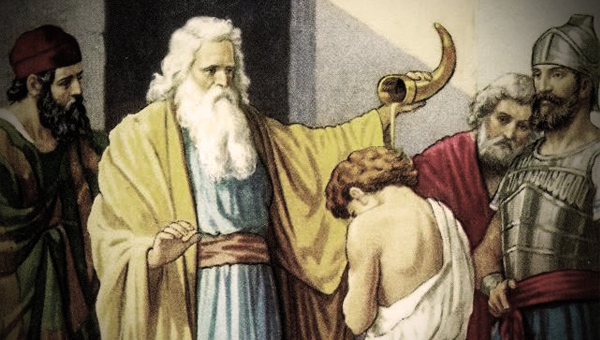
1 Samuel 15:34-16:13
Israel had to argue for its right to be ruled by a king like all the other nations. "Don't confuse yourself with other nations" says God, through the prophet Samuel. "You are different. A king will not make you great or a major player or a big fish. You are unique - ruled as you are by judges and informed by prophets"
Nonetheless Israel's desire to be like all the other nations prevails. God relents and lets them have their king. The Reign of Saul is Israel's first stab at being completely ordinary and it is a resounding failure. Saul is rejected by God and his fate is sealed. Samuel is instructed to anoint a new king from
He finally has to ask if there are other boys that he hasn't met and Jesse admits that the youngest has been left off the list. He's been sent out to take care of the flocks while his brothers are being admired for their natural aptitudes - their ease of speech - their leadership potential. These were the boys fit to be presented to a prophet. Not the youngest. He was left off the list. David is sent for and Samuel anoints him as King.
The adjectives "big" and "little" are some of the first things we learn. We're told to think big, we can hardly wait to be big. We are attracted to big ideas, big houses, big cars and big ambitions and we will need to deal with the fact that we miss out rather a lot because of that obsession. That's the way of the world - that's the way the world thinks. We too are a unique people and we give up that uniqueness all too quickly. Our history of faith, contained in the salvation history covering the two Testaments of the Bible, is filled with stories of world changing events taking place in out-of-the-way locations and with quite ordinary people initiating those events at the behest of God's voice. The stone which the builders rejected becomes the capstone of the arch. Tiny mustard seeds grow into great and commodious plants within the garden - in whose branches the birds of the air can make their nests. Suffering becomes victory. Weakness proves to be strength.
The ordinary logic of the world does not explain what happens in the life of faith.
Think again. "Big" and "little" just don't cover it
Posted by
Raspberry Rabbit
at
6/13/2015
0
comments
Labels: 500 words on a reading
Friday, June 05, 2015
The Second Sunday after Pentecost
Proper 5 - Year B
2 Corinthians 4:13-15:1
When you're threatened enough you'll look around for something heavy or pointy enough to throw overhand at whatever opponent stands in your path. If you receive a large and unexpected bill in the post you'll dig out the bank statements to see what sort of liquid resources you have to pay your way out of trouble. You put your trust in the Bank of England, or in the reliability of a good diesel engine or maybe in Smith & Wesson. Please insert here whichever tool or resource you choose which you believe will ensure that you make it to the next point in your journey. You are strong and able. You can list the resources you have at hand to keep yourself on the top step. It may be a long list.
Anytime we generalize about the state of human beings around the world or across time and use a term like, say, "the human condition" we are usually referring to where humans find themselves when their strength runs out and when their natural goodness reaches its limit. Even calling it "the human condition" pretty well lets the secret out, doesn't it? We are not really that strong. If we are strong we tend to be strong for a season only. There is something illusory or at least temporary about the visible tools and structures with which we ensure our future.
Saint Paul wants the members of the Church in Corinth (or in Clermont-Ferrand) to look beyond what they can see and touch and to find the ground of their confidence in what God is building, invisibly, in and among and around them.
Paul is not writing to impractical people. He is writing to a mixed community of urban Christians - many of whom are well-equipped with earthly resources - and he is telling them that the building blocks of faith, hope, love and perseverance will build them a home. Their worship will create a
world. What the skeptic might deny has, for them, the greatest and the most enduring reality. God is making them a home which surpasses any ability they may have to fend for themselves. The strong and the well equipped are not as safe as they think they are. The weak may well not be so weak.
Learn this. Teach it to your children. Let it be a part of your discourse as Christians. It is nothing other than what Jesus taught us in the Parables of the Kingdom - that God provisions his people in ways that the world neither sees nor understands. The smallest seeds can become the greatest shrubs in the garden.
Posted by
Raspberry Rabbit
at
6/05/2015
0
comments
Labels: 500 words on a reading